
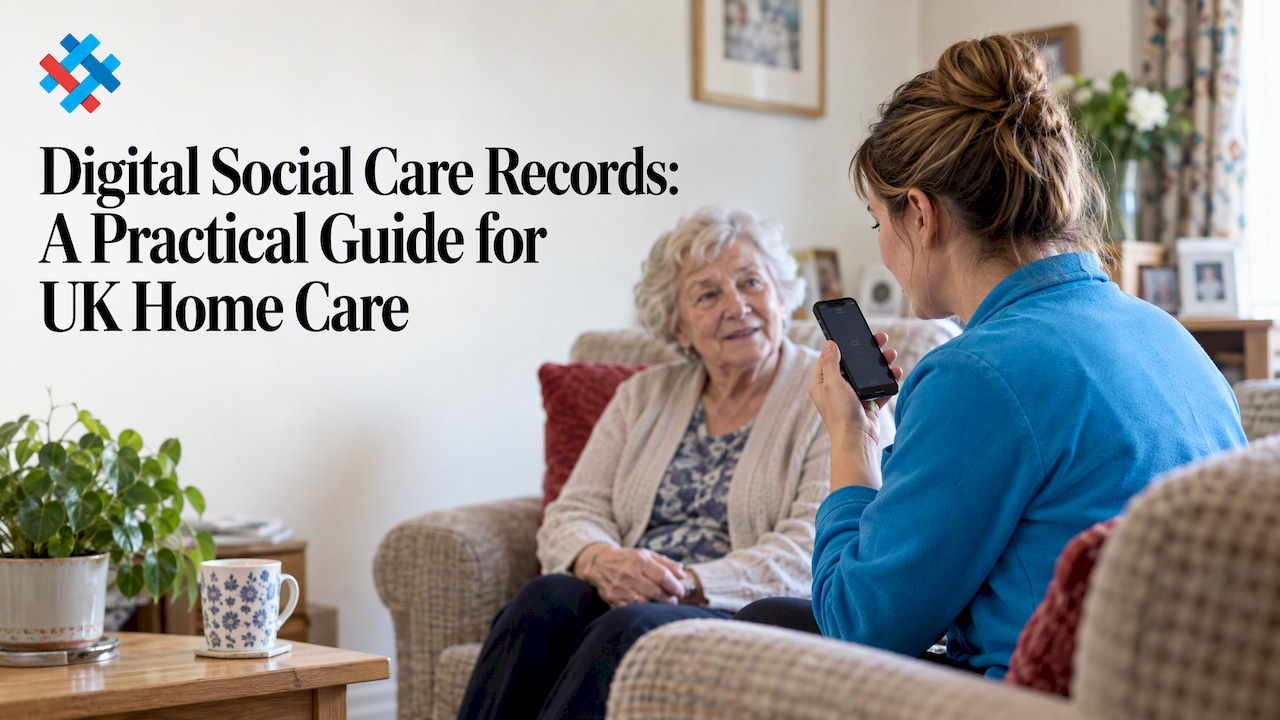
Digital social care records (DSCRs) are software that holds a person’s care information electronically, in place of paper files. For a home care provider, that means assessments, care plans, daily notes, medication records and incident reports are written and read on a phone, tablet or computer, not carried between the office and the front door. This guide explains what they contain, what the evidence says about savings, what the rules expect, and how to get the paperwork side working well in a domiciliary care branch.
TL;DR
- A DSCR is a software solution that records a person’s care information and replaces paper, according to government guidance.
- Government figures from December 2025 say four in five care providers now use them, with an estimated 30 million administrative hours saved a year.
- Choosing the system is only half the job. Staff adoption, a phased rollout and data security decide whether the time savings arrive.
- The slowest part of most home care records is still writing up the assessment and care plan. That is where speech-to-text drafting helps most.
- Weave works beside the care system you already run, so you can reduce care plan paperwork without a migration.
Table of Contents
- What digital social care records are
- Why home care is the sharp end of the paperwork problem
- What the evidence says about time and cost savings
- Paper versus digital: what actually changes
- What the rules expect from you
- How to choose a system: a checklist for a home care branch
- Rolling it out so it sticks
- Where the time still goes: assessments and care plans
- Our perspective
- Using Voice To Care Plan alongside your care system
- Making the move without losing sleep over compliance
- FAQ
- Sources
What digital social care records are
The official definition is plain. A digital social care record is a software solution for recording a person’s care information, and it replaces traditional paper-based record keeping. You will also hear the same thing called an electronic care plan or a care management system. The government’s guidance on choosing and implementing solutions uses these terms interchangeably.
What sits inside a record depends on the service, but the Local Government Association lists the usual content:
- demographic details
- health conditions, including diagnoses, allergies and medical history
- medication administration
- care needs
- risk assessments, such as falls and pressure sores
- records of daily care tasks, such as hydration and mobility support
If you manage a domiciliary care branch, you will recognise this as the file that used to live in a folder in the person’s home, with a duplicate in the office.
Why home care is the sharp end of the paperwork problem
Residential settings have a building, a desk and a nurses’ station. Home care has a car and a phone. The LGA notes that DSCRs can reduce the travel home care staff make back to the office to update paper records, make care information easier to access and update, and reduce administration.
That last point matters for each role in a branch:
- Carers log visits as they happen instead of remembering them later.
- Field care supervisors and assessors complete assessments and reviews without duplicate typing at the end of a long day.
- Office staff see current information instead of chasing paper.
- Care managers and registered managers can pull records and audit trails when they need to evidence quality.
The daily visit log is only one part of the burden. The heavier piece is often the assessment and the care plan that comes from it. We come back to that below.
What the evidence says about time and cost savings
Two sets of figures are worth knowing, and both should be read as estimates rather than guarantees for your branch.
The first is national. In a December 2025 government announcement, the Department of Health and Social Care said four in five care providers (80%) now use DSCRs. It estimated that 30 million administrative hours would be saved each year, and at least 20 minutes saved per care worker per shift.
The second is a single provider case. An LGA case study on the Priory Group’s implementation across 190 care homes anticipated a 161% return on investment with a seven-month payback period. Note the word anticipated: it is a projection for a large residential operator, not a promise for a small home care agency.

A fair way to use these numbers is to build your own baseline. Before you change anything, measure how long a typical assessment takes from the visit to a signed-off care plan, how many hours the office spends on re-keying, and how many days late records usually are. Then you have something to compare against.
Paper versus digital: what actually changes
| Area | Paper records | Digital social care records |
|---|---|---|
| Where information lives | In the home and in the office | In one system, accessed on a device |
| Updating | Written by hand, often copied again later | Entered once, available to those with access |
| Travel | Staff return to the office to update files | Less need to travel back to update records |
| Oversight | Spot checks of folders | Reporting and audit trails (when the system offers them) |
| Risk of loss | Lost, damaged or illegible files | Needs cyber security and access control instead |
The last row is the honest trade. Digital records remove one set of risks and introduce another, which is why the data protection section below matters.
What the rules expect from you
There is no single law titled “digital records”, but several expectations apply to a provider in England. The sources here are English, so if you operate in Scotland, Wales or Northern Ireland, check your own regulator’s guidance.
Data security and the DSPT
Providers should use the Data Security and Protection Toolkit (DSPT), the sector’s official self-assessment tool, and include data and cyber security in business continuity plans, according to a government social care blog on cyber-crime. The same post says providers must comply with the DSPT or an equivalent as a minimum. Ask any supplier how their product supports your DSPT submission, and where your data is stored. Weave keeps data in UK and EU data centres.
Record keeping standards
The CQC points providers to the Records Management Code of Practice for Health and Social Care (2021) in its list of best practice sources. It sets out how to manage records correctly, including those that sit in digital systems.
Data standards and sharing
The Adult Social Care Record Minimum Operational Data Standard (DAPB4102) defines a data model for DSCRs that aligns with national and international standards, to support interoperability with NHS and wider health systems. NHS England’s implementation guidance gives compliance by August 2025. In practice, you do not need to read the standard line by line. You need to ask your supplier whether their system conforms to it.
Some systems also connect to GP Connect, so that authorised social care staff can securely view limited medical information, such as recent encounters, current medications and allergies, inside the record. That is useful for a supervisor preparing a review, because the information is in front of them and they do not have to phone the surgery.
Good governance and CQC
Government guidance says providers can assess systems against their needs by checking that they offer care planning, recording, reporting and audit trails, that they meet national quality and security standards, and that they help comply with CQC regulations on good governance. We cover inspection readiness in more detail in our guide to preparing for a CQC inspection.
How to choose a system: a checklist for a home care branch
Use the criteria from the official guidance, then add the questions that matter on a daily round.
- Does it cover what you do? Care planning, recording, reporting and audit trails should all be there, as the government guidance sets out.
- Does it meet security and quality standards? Ask for evidence, and for how it supports your DSPT work.
- Does it work on poor signal? Many homes have patchy coverage. Ask what happens offline.
- Can it share data? Check standards conformance and any NHS connections you need.
- How long does a care plan take? Ask to see an assessment go from visit to finished plan, timed.
- Will your team actually use it? A simple screen beats a feature-rich one that supervisors avoid.
If your answers to the first five are good but the sixth is uncertain, put more effort into the rollout, not into another demo.
Rolling it out so it sticks
The government’s guidance is consistent on the human side. Providers should involve staff early, appoint digital champions, plan a phased implementation, keep paper records temporarily, and train staff. Here is how that looks in a home care branch.
- Start with the sceptics, not the enthusiasts. Ask a long-serving carer and a field supervisor what slows them down today. Their list becomes your success measure.
- Name digital champions. One in the office and one or two in the field, with time set aside to help colleagues.
- Phase it. Move one team or one type of record first. Keep paper as a backup for a defined period, then retire it.
- Train in the real setting. A short session in the branch, then a supervised first week, works better than a long classroom day.
- Review after a month. Check completion times, late records and staff comments against the baseline you set.
Where the time still goes: assessments and care plans
Daily visit logging is the part of a DSCR that gets the most attention. But ask a field care supervisor where their evenings go and the answer is often the same: writing up the assessment. A conversation in someone’s living room covers needs, risks, preferences, medication and routines. Turning it into a structured care plan can take far longer than the conversation itself.
A research paper on routine data collection in home care makes a related point. It suggests that an embedded home care Minimum Data Set could create a ‘sea change’ in monitoring the impact of home care, provided the data collection demands on staff are reasonable. In other words, better data is only worth having if you do not exhaust the people who have to collect it.
Our perspective
We built Weave inside Cera Care, so we started from the problem a branch actually has, not from a product category. What we saw is that most branches already have a care system, and have already paid in time and training to adopt it. Asking them to move to another one is a project in itself. Most of them did not need a different record. They needed the writing to take less time.

So we did not build a replacement system. Weave runs in a sidebar in the Chrome browser, beside whatever your branch already uses, such as PASS or Access. An assessor talks through the visit, Weave drafts the care plan, a member of staff checks it, and only then does Weave fill in the forms in your care system. A person always checks before anything is saved. We think that order matters in care: the technology does the typing, and people stay responsible for the content.
The results so far are why we are confident. Weave is used every day across more than 160 Cera branches, produces over 2,500 care plans a month, and cuts the time spent on care plan write-ups by around 75%. Those are our figures from our own use, so treat them as a guide to test in your branch and not as a guarantee. Our advice is the same as the government’s: start small, involve the people doing the work, and measure before and after.
— John
Using Voice To Care Plan alongside your care system
If your branch already has a digital care record and the remaining pain is the assessment and care plan write-up, Voice To Care Plan is built for that gap. This is how it works:
- The assessor records the conversation on their phone.
- Weave turns it into a draft care plan.
- A member of staff reviews and corrects the draft.
- Once checked, Weave completes the care plan forms in your existing care system from the Chrome sidebar.
There is no system switch and no integration project. It is designed for domiciliary care, complex care and supported living providers. You can see how a branch uses it on the Weave platform page, or try it free and judge it on your own assessments.
Making the move without losing sleep over compliance
A common worry is that a faster process means weaker records. The better test is whether each record is accurate, complete, reviewed and traceable. A draft that a person checks, and a system that keeps an audit trail, can meet that test as well as a handwritten note or better. Legibility alone is a real gain.
Two practical habits help:
- Review every draft against what you heard. Speed is the aim, but checking is the control.
- Keep your DSPT evidence current. Know where data is held, who can see it and how you would respond to an incident.
We also publish a case study on CQC-compliant absence-to-incident automation showing how forms can be completed consistently for audits and incident reports.
FAQ
Are digital social care records mandatory?
The sources we used do not describe a blanket legal requirement to hold digital records. They do show strong government support, with four in five providers already using them as of December 2025. If you are unsure about your own obligations, check with your commissioners and the CQC.
What is the difference between a DSCR and an electronic care plan?
In practice, they are used to mean the same thing. Government guidance describes a DSCR as a software solution for recording care information, and notes that you may also know it as an electronic care plan or a care management system.
Do we need to replace our care system to speed up care plans?
Not necessarily. If your current system works for daily records, you can add a tool that drafts care plans from a recorded assessment and fills in the forms you already use. Weave does this from a Chrome sidebar, so you keep your existing system and your existing training.
How should we handle data protection with a new tool?
Start with the DSPT, which providers should use as the sector’s self-assessment, and include cyber security in your business continuity plan. Ask any supplier where data is stored and how access is controlled. Weave keeps data in UK and EU data centres.
How long does implementation take?
It depends on the size of your branch and how many processes you move at once. The guidance recommends a phased approach with paper kept as a temporary backup, so plan around your team’s confidence and not a fixed date.
Sources
- Digital social care records: choosing and implementing solutions (GOV.UK)
- Implementing digital social care records (Local Government Association)
- Implementing digital social care records: case studies (Local Government Association)
- Digital revolution in care saves millions of admin hours (GOV.UK)
- Social care and cyber-crime (GOV.UK social care blog)
- Sources of best practice and guidance (Care Quality Commission)
- DAPB4102 high level implementation guidance (NHS England)
- Routine data collection in home care: a national survey (Emerald Insight)