
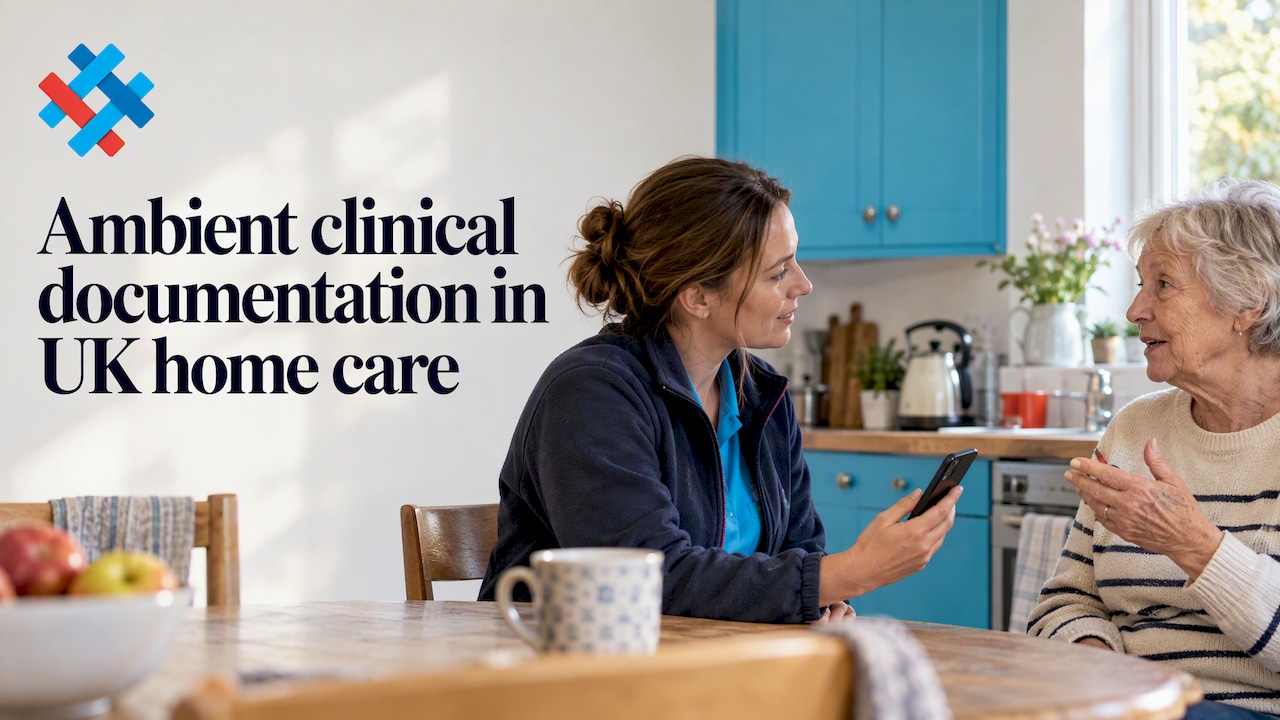
Ambient clinical documentation is software that listens to a conversation, with the person’s knowledge, and drafts the written record for a member of staff to check. In home care, that conversation is usually an assessment or a review visit, and the record is a care plan. Done well, it removes the evening write-up. Done badly, it puts unchecked text into a legal record. This guide explains how it works, what the evidence says, what UK guidance expects of you, and how to adopt it without changing your care system.
TL;DR
- Ambient documentation records a conversation and turns it into a draft note. A person must review and correct that draft before it enters the record.
- Most published evidence comes from hospital and GP settings, and much of it is short-term. It points to less documentation time, but home care evidence is thin, so run your own trial.
- In the UK you should tell people at the start, respect objections, complete a DPIA and clinical safety assessment, and keep human oversight.
- Weave’s Voice To Care Plan applies the approach to care assessments. It fills in forms in the care system you already use, from a Chrome sidebar, with no migration.
Table of Contents
- What ambient clinical documentation is
- How a conversation becomes a draft record
- Why home care is a different setting from a clinic
- What the evidence says about time and burden
- Accuracy, privacy and safety risks
- UK consent, data protection and oversight
- Questions to ask any supplier
- Our perspective on ambient documentation in home care
- How Voice To Care Plan applies the approach
- Try Voice To Care Plan on your own assessments
- A sensible rollout plan
- FAQ
- Sources
What ambient clinical documentation is
The term covers tools that capture a spoken exchange and generate structured documentation from it, without the clinician typing during the conversation. You will also see it called ambient AI scribing, ambient voice technology (AVT) or ambient clinical intelligence. In practice these names describe the same family of products.
NHS England’s guidance describes ambient scribes as tools that record conversations and take notes automatically, with possible gains in efficiency, care, workload and data quality. Academic reviews describe the technology underneath: ambient scribes combine speech recognition, natural language processing and large language models to produce structured notes.
“Ambient clinical intelligence” is the term most often used in the US. One industry definition says it documents doctor-patient exchanges in real time through voice recording, recognition and contextual transcription, and that advanced systems may even flag possible medication interactions. That last feature matters for regulation, as we explain below. For a domiciliary care provider, the useful core is simpler: talk naturally, get a draft record.
How a conversation becomes a draft record
The steps are broadly the same across products.
- Tell the person. Before recording, explain that an ambient tool is being used and give them the chance to say no.
- Record the conversation. The assessor or supervisor talks through the assessment as normal. In home care this is typically on a phone, in the person’s home.
- Transcribe. Speech recognition turns the audio into text.
- Draft. Language models organise the content into the headings and fields of a record.
- Review. A member of staff reads the draft against what they know, corrects mistakes and removes anything that should not be there.
- Save. Only after review does the content enter the care record.
Step 5 is not optional. NHS England’s guidance says professionals review and edit the notes and correct inaccuracies before the information is included in records, and that outputs should be checked every time.
There is also a good traceability habit. The American Medical Informatics Association’s best practice paper recommends linking the summary back to the original transcript, so a reviewer can see where each statement came from. It also expects review to become quicker as systems and users mature, which matches what most teams find: the first weeks are the slowest.

Why home care is a different setting from a clinic
Most ambient scribe products were built for a doctor’s consulting room: one clinician, one patient, a fixed computer. Home care looks different.
- The work happens away from a desk. Assessors and field care supervisors are in people’s homes, often with family members present and background noise.
- The output is a care plan, not a consultation note. It has to cover needs, risks, preferences, routines and outcomes, in the structure your regulator and commissioners expect.
- The record lives in a care system. Many branches use established digital care planning platforms. A tool that produces a nice summary but leaves you copying and pasting into forms has only moved the work.
- Reviewers are mixed. Office staff, supervisors and managers all touch the record, so a clear check-before-save step matters.
That last gap, between a transcript and a completed form, is where many ambient tools stop short. We wrote about it in a case study on closing the AI integration gap.
What the evidence says about time and burden
The honest answer is promising but uneven, and mostly not from home care.
A Nuffield Trust evaluation page describes a rapid scoping review of ambient voice technology. It screened more than 500 records and found 21 eligible studies. Most were short-term pilots or quality improvement projects, often under six months. Evidence was most consistent for reductions in documentation time, and the wider NHS evaluation is still looking at benefits, challenges and value for money.
A large survey study of clinicians is not the only kind of evidence, and small studies can be mixed. One pilot in community palliative medicine, which is the closest to home-based care in the research we found, reported a significant time saving for one resident and almost none for another. The authors said the sample was too small to draw firm conclusions.
The lesson for a provider is practical:
- Expect gains in documentation time, but not identical gains for every user.
- Treat published percentages from other settings as a reason to trial, not a promise.
- Measure your own baseline first: how long does a care plan write-up take now, and how long after?
One US clinician, quoted by UChicago Medicine, says ambient documentation lets doctors focus more fully on patients and spend less time looking at the computer. For an assessor sitting in someone’s living room, the same logic applies: eye contact and conversation, not a laptop screen.
Accuracy, privacy and safety risks
Ambient tools make mistakes. They can mishear names, medication or dosages, attribute a statement to the wrong person, or write something that sounds plausible but was never said. A reviewer who skims will miss these.
The NHS Scotland interim position is direct: without the specified safeguards, use of ambient voice technology presents risks to patient safety and data protection. It asks organisations to define measures of accuracy and reliability, and to sense-check outputs before onward use.
The academic literature adds that implementation involves workflow redesign and medico-legal considerations, and that responsibility for the accuracy of the final record stays with the person who signs it off. In home care, that is your assessor or supervisor, not the software.
A short review checklist for staff
- Names, dates, addresses and contact details are correct.
- Medication names, doses and times match the source documents.
- Risks, such as falls, skin integrity, moving and handling, and safeguarding concerns, are present and not softened.
- The person’s own preferences are in their words where it matters.
- Nothing is included that was not said or observed.
- Anything the software added as a judgement or suggestion has been removed or confirmed.
UK consent, data protection and oversight
There is no single UK rulebook written only for home care providers, so you work from several sources. Which applies depends on where you are. NHS England, NHS Scotland and NHS Wales have each published their own material, and CQC regulates adult social care in England.
Transparency and objection. NHS England says that, for individual care, you should inform people at the start of the session, respect any objection, and make information about the ambient scribe available in your privacy notice. If someone says no, you document by hand.
DPIA and clinical safety. NHS Scotland expects deploying organisations to complete data protection impact assessments, clinical safety risk assessments and system security plans before using ambient voice technology. CQC’s page on AI in health and social care also lists a DPIA among its expectations, alongside the principle that AI supports rather than replaces human decision making and that outputs are monitored.
Medical device status. The same Scottish paper says AVT products that generate summaries should be at least Class I medical devices, and in many cases Class II, and that extra capabilities can change the classification. Ask any supplier what their regulatory position is.
Summarise, don’t decide. NHS Wales says ambient tools should support summarisation, not diagnosis or treatment-plan decision support, except in agreed testing or research. This is a useful design test for a care plan tool: it should draft what was said, not decide what the person needs.
Where the data sits. Ask where audio and transcripts are stored, who can access them, how long they are kept and whether they are used to train models. Weave keeps data in UK and EU data centres.
Questions to ask any supplier
| Area | What to ask |
|---|---|
| Review | Can a person edit everything before it is saved? Is the transcript kept alongside the draft? |
| Fit | Does it fill your existing care system’s forms, or only produce a document to copy? |
| Data | Where is audio stored, for how long, and who can access it? |
| Governance | Is there DPIA support and clinical safety documentation? What is the device classification position? |
| Scope | Does it summarise what was said, or does it make recommendations? |
| Rollout | Is there a free trial, and what does onboarding involve? |
Our perspective on ambient documentation in home care
We built Weave inside Cera Care, one of the UK’s largest home care providers, because we saw the problem from the inside. Assessors do good work in the home and then lose hours to typing it up. Our view is that ambient documentation is worth adopting in care, with three conditions.
First, a person checks every draft before anything is saved. That is how Voice To Care Plan works, and we would not build it any other way. The software drafts, your member of staff decides.
Second, it must fit the system you already run. A care plan is useful only when it is in the care record, in the right fields, where the rest of the team and the inspector will look. So Weave does not replace your care system. It runs in a Chrome sidebar beside the one you use, and fills in the forms after the check. No migration, no integration project.
Third, measure it. Weave is used every day across more than 160 Cera branches, producing over 2,500 care plans a month, and it has cut time spent on care plan write-ups by around 75%. Those figures come from our own branches. Your result will depend on your assessment style and your staff, so set a baseline and compare.
— John
How Voice To Care Plan applies the approach
Voice To Care Plan is built for field care supervisors and assessors in domiciliary care, complex care and supported living.
- Record the assessment conversation on your phone.
- Weave transcribes it and turns it into a draft care plan.
- A member of staff reads and corrects the draft.
- Once checked, Weave fills in the care plan forms in your existing care system from the sidebar.
You can see the output before you commit. Our sample assessment transcript shows what a conversation looks like on the page, and the Voice To Care Plan page explains each step.
The same approach extends beyond care plans. The Weave platform supports workflow automation, such as completing forms for audits and incident reports without engineering work. Our CQC-compliant absence-to-incident case study shows one example, and our guides on digital social care records and healthcare workflow automation cover the wider context.
Try Voice To Care Plan on your own assessments
We offer a free trial, after which the service moves to a paid per-user plan. There is no published price to quote here, so ask us for current terms.
Start with Voice To Care Plan. Try it free on your next assessment and compare the write-up time with your current baseline.
A sensible rollout plan
- Pick a small group. Choose two or three assessors or supervisors, including one sceptic.
- Record your baseline. Note the average time to write up an assessment into a care plan today.
- Complete your governance. Finish the DPIA and clinical safety assessment, update your privacy notice and agree your consent wording.
- Write a review standard. Use a checklist like the one above, and decide who signs off.
- Trial for several weeks. Track time, edits made, errors caught and staff feedback.
- Prepare for inspection. Be ready to explain how the tool is used and how people stay in control. Our guide on preparing for a CQC inspection is a good companion.
- Expand. Add branches once the checklist is working in practice.
FAQ
Is ambient clinical documentation the same as ambient clinical intelligence?
In everyday use, yes. Both describe tools that listen to a conversation and draft a record. Ambient clinical intelligence is the more common phrase in the US, and some definitions include extras such as flagging medication interactions. For care plans, the key feature is accurate drafting that a person reviews.
Do we have to tell people we are using it?
Yes, as a matter of good practice and current NHS England guidance. You should tell people at the start of the session, respect any objection, and cover it in your privacy notice. If someone declines, write the record by hand.
Can the software make care decisions?
It should not. Welsh guidance says these tools should support summarisation rather than diagnosis or treatment-plan decisions. CQC’s stated principle is that AI supports human decision making and does not replace it. Your staff decide what goes in the care plan.
Do we need to change our care system to use it?
Not with Weave. Voice To Care Plan works from a Chrome sidebar beside the care system your branch already uses, and fills in its forms once a member of staff has checked the draft.
Sources
- Using AI-enabled ambient scribing products in health and care settings (NHS England)
- Transforming clinical documentation with ambient artificial intelligence (PMC)
- What is Ambient Clinical Intelligence? (TechTarget)
- Initial Best Practices for Ambient Listening (AMIA)
- Evaluation of ambient voice technology in the NHS (Nuffield Trust)
- Ambient AI scribe pilot in palliative medicine (PMC)
- What to know about AI ambient clinical documentation (UChicago Medicine)
- NHS Scotland interim position on ambient voice technologies
- Safe and responsible adoption of ambient voice technologies (Welsh Government)
- Artificial intelligence in health and social care: CQC’s role, expectations and plans